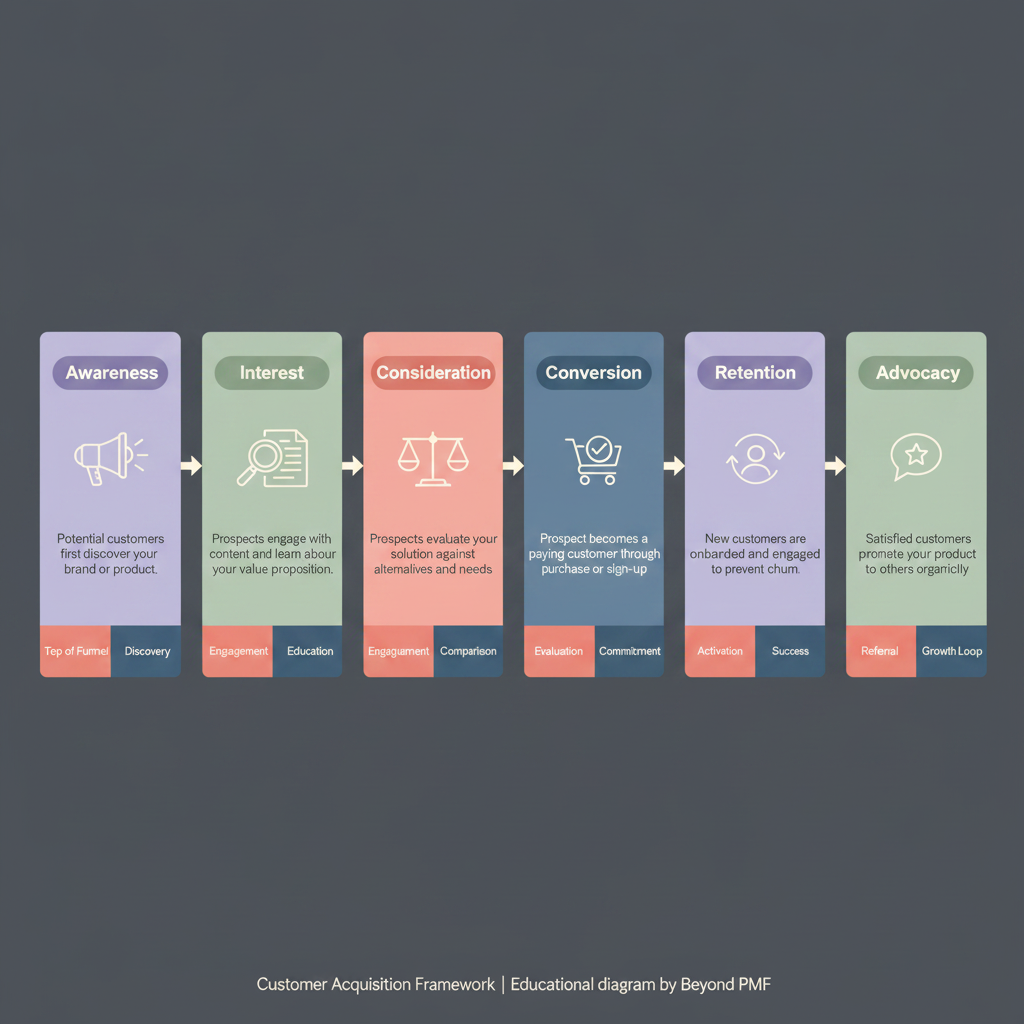
Customer Acquisition Framework

https://ik.imagekit.io/beyondpmf/frameworks/customer-acquisition-framework.png
The Customer Acquisition Framework directly addresses the efficiency with which a business gains new customers. This inherently involves the customer experience and the effectiveness of implementation efforts such as marketing and sales.

The Customer Acquisition Framework is a systematic approach designed to guide businesses in attracting and converting new customers. It involves identifying target markets, choosing the right channels, optimizing marketing strategies, and measuring the effectiveness of these strategies. This framework is crucial for businesses aiming to expand their customer base, increase revenue, and achieve sustainable growth. Its structured nature allows for continuous improvement and adaptation to changing market conditions.

Steps / Detailed Description

Identify target audience: Define who your ideal customers are based on demographic, psychographic, and behavioral characteristics. | Choose acquisition channels: Select the most effective channels for reaching your target audience, such as social media, email marketing, SEO, or paid advertising. | Develop compelling offers: Create attractive offers or incentives that encourage potential customers to make a purchase or engage with your brand. | Implement strategies: Execute the marketing campaigns and strategies across the chosen channels. | Measure and optimize: Continuously track the performance of your acquisition efforts and optimize based on data-driven insights.

Best Practices

Regularly update customer personas based on new data | Focus on high ROI channels | Use A/B testing to refine marketing messages and offers

Pros

Structured approach to customer acquisition | Enables targeted marketing efforts | Facilitates measurement and optimization of strategies

Cons

Can be resource-intensive | Requires continuous adaptation to be effective | Potential for high initial costs

When to Use

When launching a new product or service | When entering a new market

When Not to Use

In highly saturated markets without differentiation | When the business lacks resources to sustain a planned acquisition strategy

Related Frameworks

Lifecycle

Scope

Scope not defined

Maturity Level

Maturity level not specified

Time to Implement

2–4 Weeks
3–6 Months
1–2 Weeks
3–6 Months
1–2 Months
3–6 Months
1–2 Weeks
Less Than 1 Day
1–2 Weeks
Longer Than 6 Months
1–2 Weeks
Longer Than 6 Months
1–2 Weeks
3–6 Months
1–2 Weeks
1–2 Weeks
1–2 Weeks
1–2 Weeks
1–2 Days
1–2 Weeks
1–2 Weeks
1–2 Weeks
1–2 Weeks
1–2 Weeks
1–2 Weeks
3–6 Months
1–2 Weeks
1–2 Weeks
1–2 Weeks
3–6 Months
1–2 Weeks
1–2 Weeks
2–4 Weeks
1–2 Weeks
1–2 Days
1–2 Weeks
Longer Than 6 Months
3–6 Months
Longer Than 6 Months
1–2 Weeks
Longer Than 6 Months
3–6 Months
Less Than 1 Day
3–6 Months
1–2 Months
3–6 Months
Longer Than 6 Months
3–6 Months
Less Than 1 Day
1–2 Weeks
3–6 Months
3–6 Months
1–2 Weeks
3–6 Months
1–2 Weeks
1–2 Weeks
1–2 Days
1–2 Weeks
1–2 Months
Longer Than 6 Months
1–2 Weeks
Longer Than 6 Months
1–2 Weeks
3–6 Months
1–2 Weeks
Less Than 1 Day
1–2 Weeks
3–6 Months
1–2 Weeks
3–6 Months
1–2 Weeks
1–2 Weeks
Longer Than 6 Months
Less Than 1 Day
3–6 Months
Longer Than 6 Months
1–2 Months
1–2 Weeks
Longer Than 6 Months
1–2 Weeks
3–6 Months
1–2 Weeks
1–2 Weeks
3–6 Months
Less Than 1 Day
1–2 Weeks
1–2 Weeks
3–6 Months
3–6 Months
Less Than 1 Day
1–2 Weeks
Longer Than 6 Months
1–2 Months
1–2 Weeks
1–2 Weeks
1–2 Weeks
Longer Than 6 Months

Copyright Information

Autor:
Public Domain
N/A
Publication:
Generic Business Tool