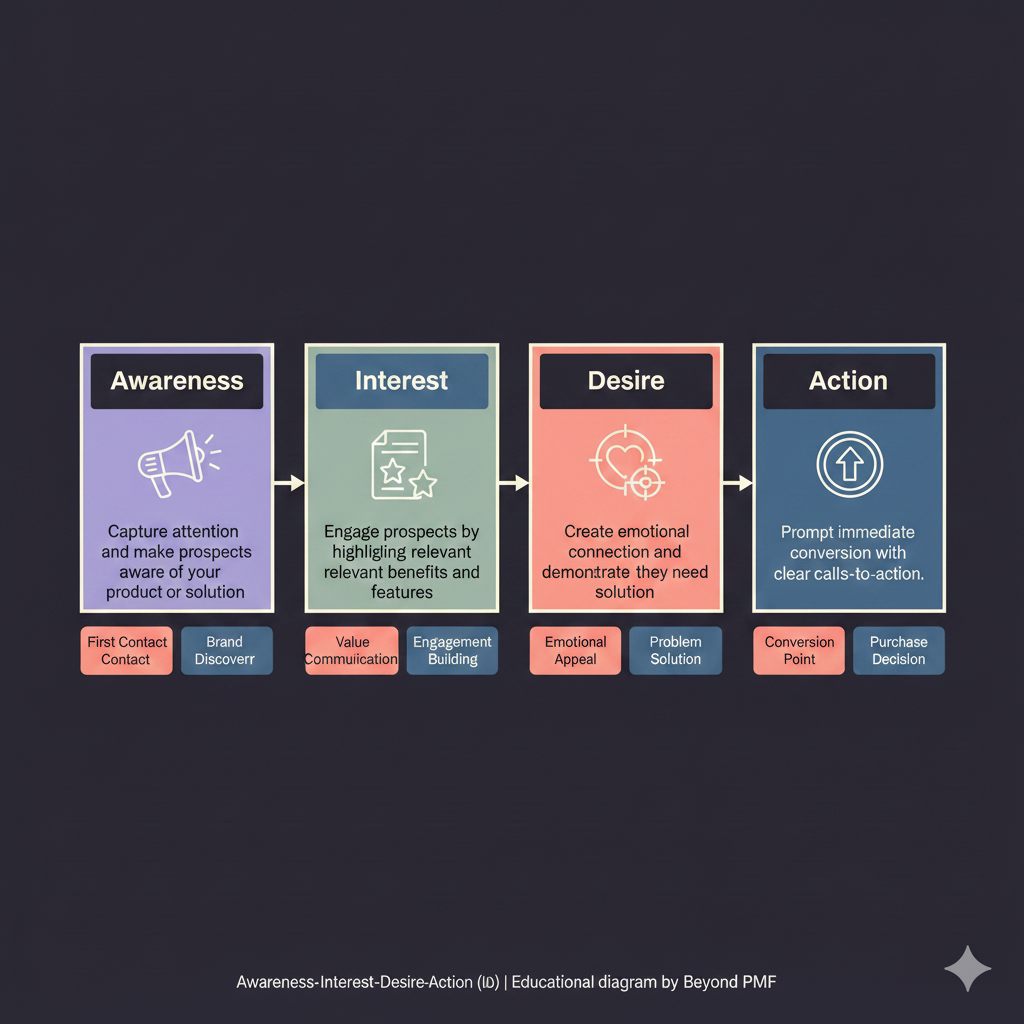
Awareness-Interest-Desire-Action (AIDA)

https://ik.imagekit.io/beyondpmf/frameworks/awareness-interest-desire-action-aida.png
The AIDA model primarily addresses the friction in customer experience and the successful delivery of marketing messages. It guides the consumer through stages that culminate in a desired action (purchase), focusing on influencing customer behavior.

The Awareness-Interest-Desire-Action (AIDA) framework is a classic marketing model that outlines the four stages a consumer goes through before making a purchase decision. It starts with creating awareness about a product or service, generating interest, building a desire for it, and finally prompting action to purchase or engage. This model helps marketers craft effective communication strategies to guide potential customers along their journey, enhancing the chances of successful conversions.

Steps / Detailed Description

Awareness: Capture the attention of the target audience through various marketing channels. | Interest: Engage them by highlighting features and benefits that meet their needs. | Desire: Create an emotional connection, making the product or service more appealing. | Action: Encourage taking steps towards purchasing or engaging with the product/service.

Best Practices

Use clear and compelling messaging at each stage. | Tailor content to the specific interests and needs of the target audience. | Continuously test and refine strategies based on feedback and analytics.

Pros

Provides a clear, structured approach to understanding consumer behavior. | Helps in designing targeted marketing strategies. | Facilitates measurement and optimization at each stage.

Cons

May oversimplify the buying process, ignoring other influences. | Not specifically tailored for new digital marketing channels. | Can be less effective without sufficient market research.

When to Use

Launching a new product or service. | Repositioning an existing product in the market.

When Not to Use

When dealing with immediate, short-term sales tactics. | In situations where the buying process is extremely short or instantaneous.

Related Frameworks

Lifecycle

Scope

Scope not defined

Maturity Level

Maturity level not specified

Time to Implement

2–4 Weeks
3–6 Months
1–2 Weeks
3–6 Months
1–2 Months
3–6 Months
1–2 Weeks
Less Than 1 Day
1–2 Weeks
Longer Than 6 Months
1–2 Weeks
Longer Than 6 Months
1–2 Weeks
3–6 Months
1–2 Weeks
1–2 Weeks
1–2 Weeks
1–2 Weeks
1–2 Days
1–2 Weeks
1–2 Weeks
1–2 Weeks
1–2 Weeks
1–2 Weeks
1–2 Weeks
3–6 Months
1–2 Weeks
1–2 Weeks
1–2 Weeks
3–6 Months
1–2 Weeks
1–2 Weeks
2–4 Weeks
1–2 Weeks
1–2 Days
1–2 Weeks
Longer Than 6 Months
3–6 Months
Longer Than 6 Months
1–2 Weeks
Longer Than 6 Months
3–6 Months
Less Than 1 Day
3–6 Months
1–2 Months
3–6 Months
Longer Than 6 Months
3–6 Months
Less Than 1 Day
1–2 Weeks
3–6 Months
3–6 Months
1–2 Weeks
3–6 Months
1–2 Weeks
1–2 Weeks
1–2 Days
1–2 Weeks
1–2 Months
Longer Than 6 Months
1–2 Weeks
Longer Than 6 Months
1–2 Weeks
3–6 Months
1–2 Weeks
Less Than 1 Day
1–2 Weeks
3–6 Months
1–2 Weeks
3–6 Months
1–2 Weeks
1–2 Weeks
Longer Than 6 Months
Less Than 1 Day
3–6 Months
Longer Than 6 Months
1–2 Months
1–2 Weeks
Longer Than 6 Months
1–2 Weeks
3–6 Months
1–2 Weeks
1–2 Weeks
3–6 Months
Less Than 1 Day
1–2 Weeks
1–2 Weeks
3–6 Months
3–6 Months
Less Than 1 Day
1–2 Weeks
Longer Than 6 Months
1–2 Months
1–2 Weeks
1–2 Weeks
1–2 Weeks
Longer Than 6 Months

Copyright Information

Autor:
E. St. Elmo Lewis
1898
Publication:
Unknown