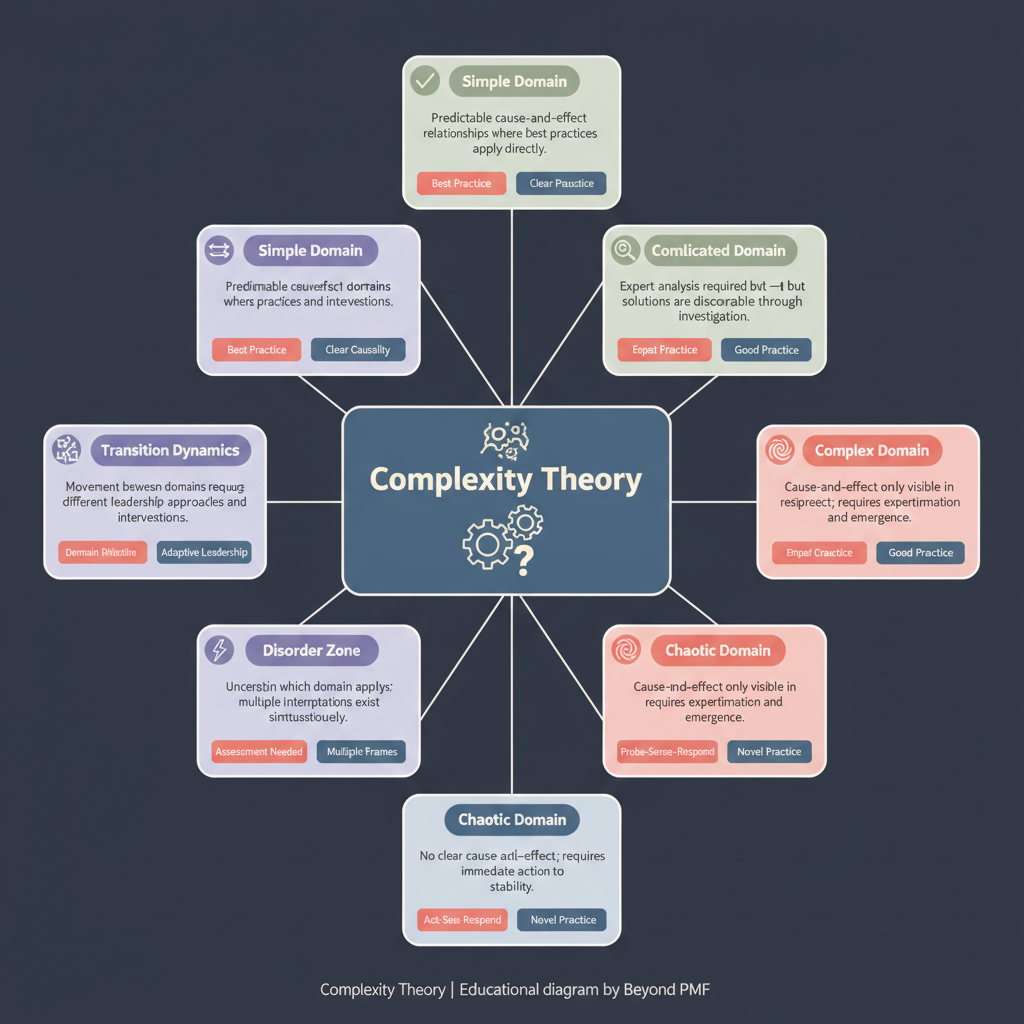
Complexity Theory

https://ik.imagekit.io/beyondpmf/frameworks/complexity-theory.png
Complexity Theory primarily addresses the friction that arises from intricate interactions within a system. This relates to operational challenges in managing and coordinating processes when the outcomes are not easily predictable.

Complexity Theory is a framework used to understand the behaviors of complex systems where numerous independent variables interact in various and unpredictable ways. It is particularly useful in fields like economics, organizational behavior, and ecology, where systems are dynamic and adaptive. The theory helps in predicting how systems respond to changes, manage uncertainty, and evolve over time, providing insights that are critical for strategic planning and decision-making.

Steps / Detailed Description

Identify the components of the system and their interactions. | Analyze how local interactions can lead to emergent global patterns. | Model the system using computational simulations to predict complex behaviors. | Iterate the model based on real-world feedback and adjustments.

Best Practices

Continuously update models with new data | Use interdisciplinary approaches for more comprehensive insights | Focus on understanding interactions rather than just components

Pros

Provides insights into the behavior of complex systems | Helps in anticipating unexpected outcomes | Supports strategic decision-making in uncertain environments

Cons

Requires high computational resources for modeling | Predictions can sometimes be inaccurate due to system unpredictability | Complex to understand and implement effectively

When to Use

When dealing with dynamic and adaptive systems | In strategic planning where long-term outcomes are uncertain

When Not to Use

In highly predictable, linear systems | When quick, definitive answers are required

Related Frameworks

Categories

Lifecycle

Not tied to a specific lifecycle stage

Scope

Scope not defined

Maturity Level

Maturity level not specified

Time to Implement

2–4 Weeks
3–6 Months
1–2 Weeks
3–6 Months
1–2 Months
3–6 Months
1–2 Weeks
Less Than 1 Day
1–2 Weeks
Longer Than 6 Months
1–2 Weeks
Longer Than 6 Months
1–2 Weeks
3–6 Months
1–2 Weeks
1–2 Weeks
1–2 Weeks
1–2 Weeks
1–2 Days
1–2 Weeks
1–2 Weeks
1–2 Weeks
1–2 Weeks
1–2 Weeks
1–2 Weeks
3–6 Months
1–2 Weeks
1–2 Weeks
1–2 Weeks
3–6 Months
1–2 Weeks
1–2 Weeks
2–4 Weeks
1–2 Weeks
1–2 Days
1–2 Weeks
Longer Than 6 Months
3–6 Months
Longer Than 6 Months
1–2 Weeks
Longer Than 6 Months
3–6 Months
Less Than 1 Day
3–6 Months
1–2 Months
3–6 Months
Longer Than 6 Months
3–6 Months
Less Than 1 Day
1–2 Weeks
3–6 Months
3–6 Months
1–2 Weeks
3–6 Months
1–2 Weeks
1–2 Weeks
1–2 Days
1–2 Weeks
1–2 Months
Longer Than 6 Months
1–2 Weeks
Longer Than 6 Months
1–2 Weeks
3–6 Months
1–2 Weeks
Less Than 1 Day
1–2 Weeks
3–6 Months
1–2 Weeks
3–6 Months
1–2 Weeks
1–2 Weeks
Longer Than 6 Months
Less Than 1 Day
3–6 Months
Longer Than 6 Months
1–2 Months
1–2 Weeks
Longer Than 6 Months
1–2 Weeks
3–6 Months
1–2 Weeks
1–2 Weeks
3–6 Months
Less Than 1 Day
1–2 Weeks
1–2 Weeks
3–6 Months
3–6 Months
Less Than 1 Day
1–2 Weeks
Longer Than 6 Months
1–2 Months
1–2 Weeks
1–2 Weeks
1–2 Weeks
Longer Than 6 Months

Copyright Information

Autor:
Public Domain
N/A
Publication:
Generic Business Tool