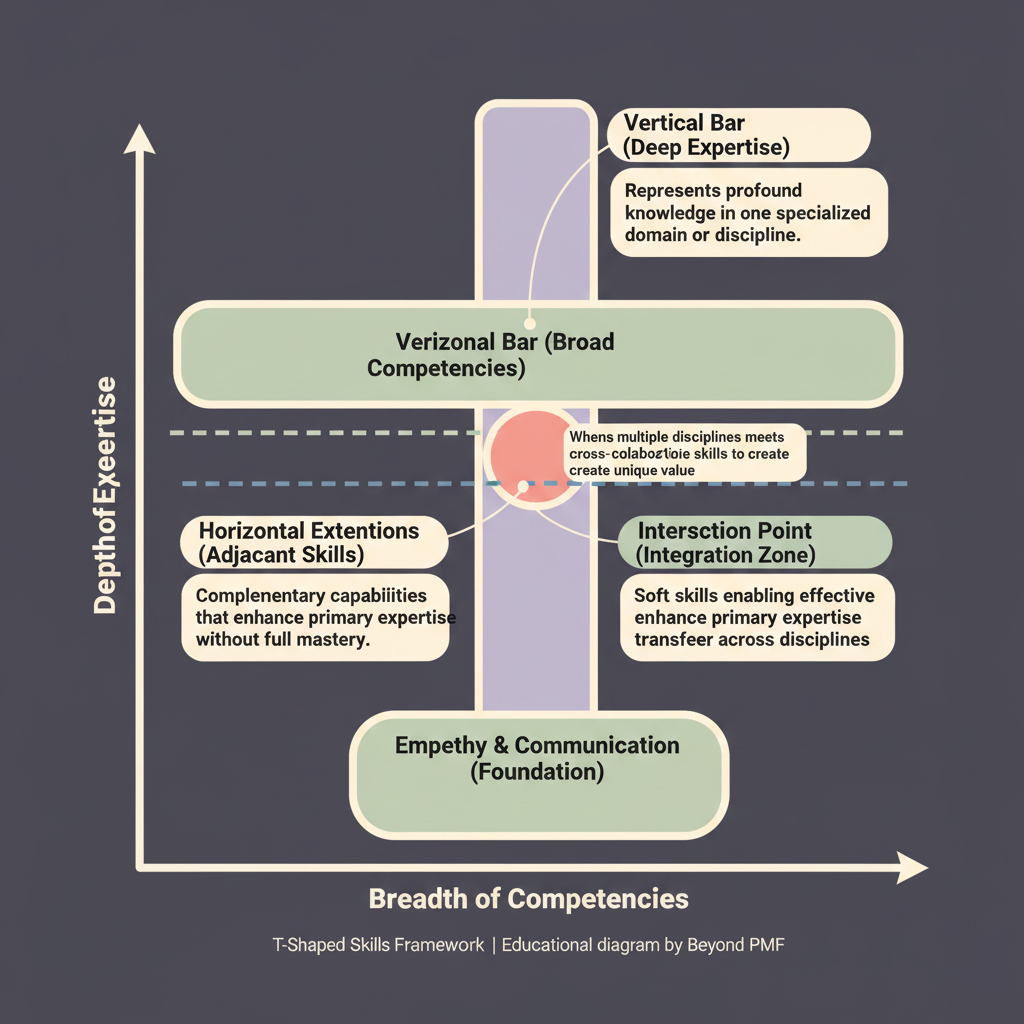
T-Shaped Skills Framework

https://ik.imagekit.io/beyondpmf/frameworks/t-shaped-skills-framework.png
The T-Shaped Skills Framework primarily addresses structural friction by influencing how individuals are organized and contribute within a team. By emphasizing both deep expertise and broad knowledge, it aims to reduce structural issues related to unclear roles, knowledge silos, and cross-functional communication breakdowns. This helps in improving team alignment and overall organizational design.

The T-Shaped Skills Framework is a concept used in job development and organizational planning. It refers to individuals who possess deep knowledge and skills in a particular area of specialization (the vertical stroke of the 'T'), alongside a broader but shallower range of skills and knowledge in other areas (the horizontal stroke of the 'T'). This framework helps in creating versatile employees who can contribute deeply to their specialty while collaborating across disciplines, enhancing innovation and problem-solving capabilities within organizations.

Steps / Detailed Description

Identify the core area of specialization. | Develop deep, specialized skills in the core area. | Acquire broad knowledge in other relevant areas. | Integrate and apply cross-disciplinary knowledge.

Best Practices

Continuous learning and skill development. | Regularly update knowledge on emerging trends. | Encourage cross-functional team collaborations.

Pros

Enhances job marketability by combining depth with breadth. | Facilitates better collaboration and innovation within teams. | Adapts to changing job requirements and industries.

Cons

Can be challenging to maintain expertise in all areas. | May dilute focus from primary specialization. | Requires continuous learning and adaptation.

When to Use

In rapidly evolving industries. | When building cross-functional teams.

When Not to Use

In highly specialized fields requiring deep, narrow focus. | When the job role requires exclusive expertise without breadth.

Related Frameworks

No related frameworks listed

Lifecycle

Not tied to a specific lifecycle stage

Scope

Scope not defined

Maturity Level

Maturity level not specified

Time to Implement

2–4 Weeks
3–6 Months
1–2 Weeks
3–6 Months
1–2 Months
3–6 Months
1–2 Weeks
Less Than 1 Day
1–2 Weeks
Longer Than 6 Months
1–2 Weeks
Longer Than 6 Months
1–2 Weeks
3–6 Months
1–2 Weeks
1–2 Weeks
1–2 Weeks
1–2 Weeks
1–2 Days
1–2 Weeks
1–2 Weeks
1–2 Weeks
1–2 Weeks
1–2 Weeks
1–2 Weeks
3–6 Months
1–2 Weeks
1–2 Weeks
1–2 Weeks
3–6 Months
1–2 Weeks
1–2 Weeks
2–4 Weeks
1–2 Weeks
1–2 Days
1–2 Weeks
Longer Than 6 Months
3–6 Months
Longer Than 6 Months
1–2 Weeks
Longer Than 6 Months
3–6 Months
Less Than 1 Day
3–6 Months
1–2 Months
3–6 Months
Longer Than 6 Months
3–6 Months
Less Than 1 Day
1–2 Weeks
3–6 Months
3–6 Months
1–2 Weeks
3–6 Months
1–2 Weeks
1–2 Weeks
1–2 Days
1–2 Weeks
1–2 Months
Longer Than 6 Months
1–2 Weeks
Longer Than 6 Months
1–2 Weeks
3–6 Months
1–2 Weeks
Less Than 1 Day
1–2 Weeks
3–6 Months
1–2 Weeks
3–6 Months
1–2 Weeks
1–2 Weeks
Longer Than 6 Months
Less Than 1 Day
3–6 Months
Longer Than 6 Months
1–2 Months
1–2 Weeks
Longer Than 6 Months
1–2 Weeks
3–6 Months
1–2 Weeks
1–2 Weeks
3–6 Months
Less Than 1 Day
1–2 Weeks
1–2 Weeks
3–6 Months
3–6 Months
Less Than 1 Day
1–2 Weeks
Longer Than 6 Months
1–2 Months
1–2 Weeks
1–2 Weeks
1–2 Weeks
Longer Than 6 Months

Copyright Information

Autor:
Unknown
N/A
Publication:
Generic Business Tool