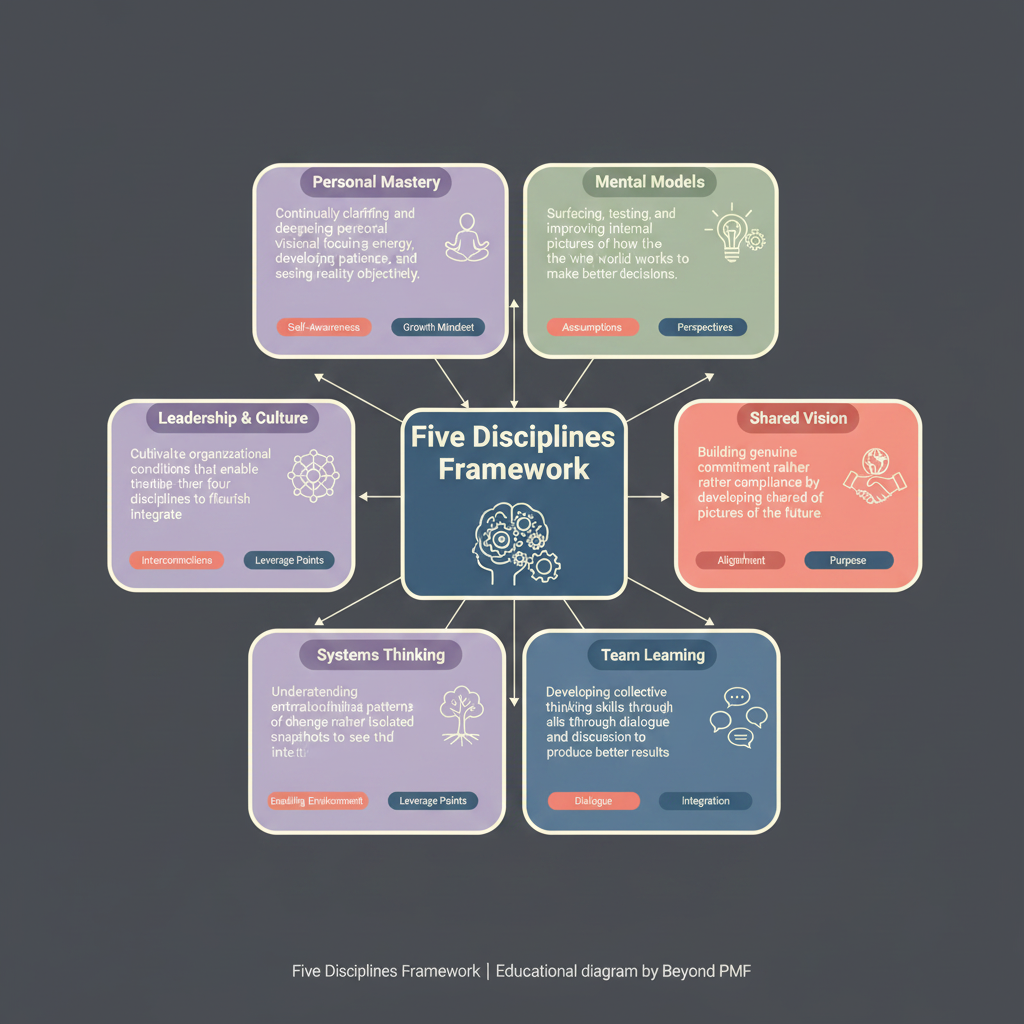
The Five Disciplines Framework, conceptualized by Peter Senge in his book 'The Fifth Discipline', is designed to help organizations create environments conducive to continuous learning and improvement. It emphasizes the importance of five interconnected disciplines: Personal Mastery, Mental Models, Shared Vision, Team Learning, and Systems Thinking. This framework is used to foster innovation, adaptability, and deeper understanding among team members, leading to enhanced organizational performance.
Personal Mastery: Encouraging individual commitment to learning and personal growth. | Mental Models: Identifying, challenging, and improving internal images of the world, and understanding how they shape actions and decisions. | Shared Vision: Building a common vision that fosters genuine commitment and engagement rather than compliance. | Team Learning: Promoting group interaction that maximizes the intellectual potential of team members. | Systems Thinking: Understanding the interrelationships between the parts of a system and the system as a whole, which is the cornerstone discipline that binds the other four.
Ensure leadership commitment and modeling of the disciplines | Regularly review and update mental models to stay relevant | Foster open communication and shared learning experiences
Enhances adaptability and responsiveness to changes | Promotes a continuous learning culture within the organization | Improves overall organizational communication and alignment
Requires significant time and commitment to implement effectively | Can be challenging to measure direct impact on performance | May encounter resistance due to change in organizational culture
In organizations needing a shift towards a more collaborative and learning-oriented culture | When facing complex issues that require systemic thinking
In very small or less complex organizations where the setup might be too extensive | When immediate results are required, as the benefits of the framework take time to manifest